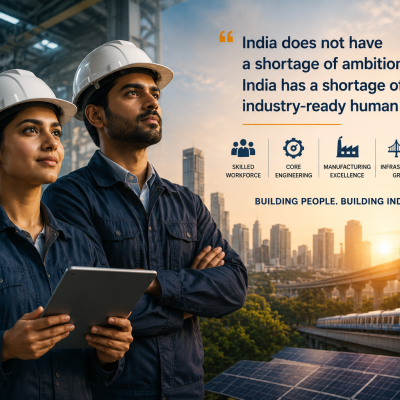
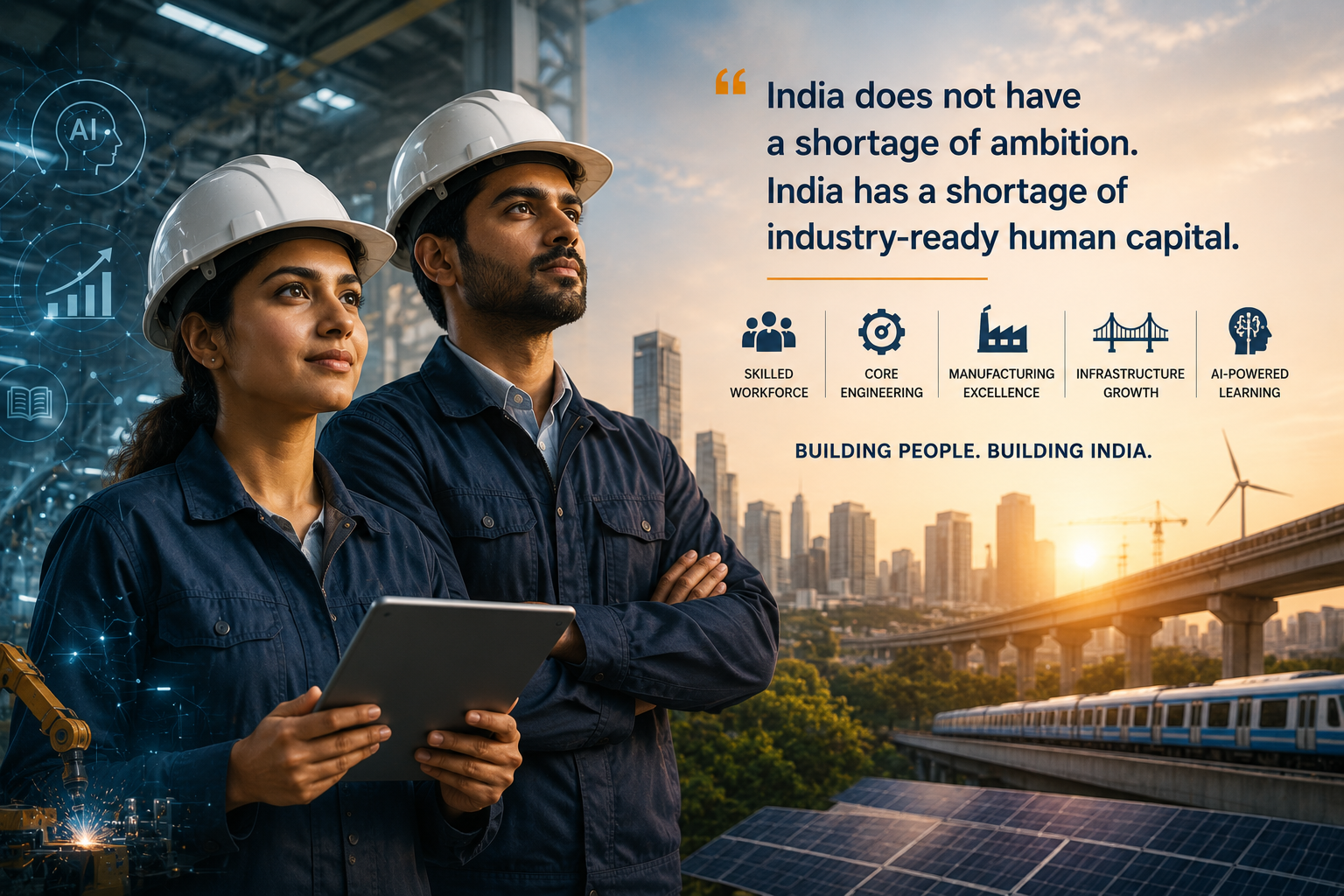
“India does not have a shortage of ambition. India has a shortage of industry-ready human capital.”
Human Capital: What India Needs to Become a World Leader in Skilling for Core Engineering, Manufacturing, and Infrastructure
India does not have a shortage of ambition. India has a shortage of industry-ready human capital.
The country is expanding at historic speed. Manufacturing is accelerating. Infrastructure is scaling. Core engineering sectors are carrying the weight of nation building. Yet one truth remains unavoidable: our human potential is still not being transitioned into productive industrial capability at the pace the country now demands.
India cannot become a world leader in core sectors by building projects alone. India must build people.
The real gap
For years, we have focused on degrees, not deployment. We have measured education by completion, not by capability.
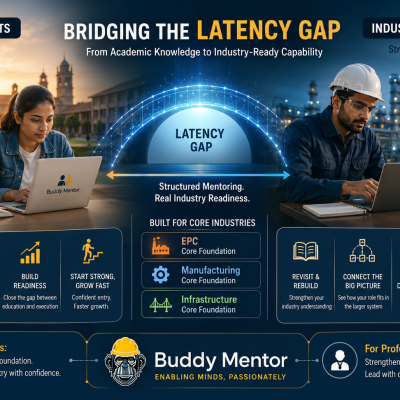
Every year, institutions produce diploma holders and degree engineers in large numbers. But industry does not absorb certificates. Industry absorbs competence. It needs people who can understand standards, apply logic, work with discipline, respond to failure, think in systems, and contribute with confidence from day one.
That is where the gap begins.
Students leave institutes with academic exposure, but many enter industry without a structured transition into practice. They know the subject, but not always the workplace. They know the theory, but not always the logic of application. They know the syllabus, but not always the standards, field realities, or failure lessons that shape industrial performance.
This is not a small educational gap. This is a national productivity gap.
India needs a skilling shift
If India needs to lead the world in engineering, manufacturing, and infrastructure, then India must lead the world in skilling for these sectors.
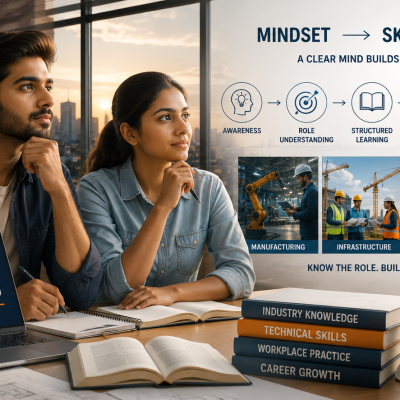
That means we must stop treating skilling as an add-on. It is not an optional finishing layer after education. It is the bridge between education and economic value.
Core sectors do not run on enthusiasm alone. They run on prepared people. Plants, projects, systems, utilities, production lines, and engineering assets depend on professionals who are technically grounded, operationally aware, and ready to perform in real contexts.
Without that transition, growth slows down at the last mile:
- Employers spend more time on basic onboarding.
- Fresh graduates take longer to become productive.
- Experienced professionals continue working without structured foundation reinforcement.
- Institutions struggle to prove placement readiness beyond academic completion.
India cannot afford this mismatch anymore.
The AI era changes the equation
This is precisely why the AI era matters.
Artificial intelligence should not be seen only as a disruption to jobs. It should be used as an accelerator for human capability. India now has the opportunity to build technologically advanced, scalable, and robust skilling systems that were not possible before.
AI can help personalize learning. It can support progression. It can improve engagement. It can strengthen consistency. But most importantly, when combined with the right mentoring architecture, AI can help move learners from passive content consumption to active skill formation.
That is the real opportunity.
Not just more content. Better transition.
Not just more courses. Better capability.
Not just digital access. Better industrial readiness.
What a national solution must include
If India is serious about becoming a world leader in skilling for core sectors, then the approach must be practical, structured, and industry-aligned.
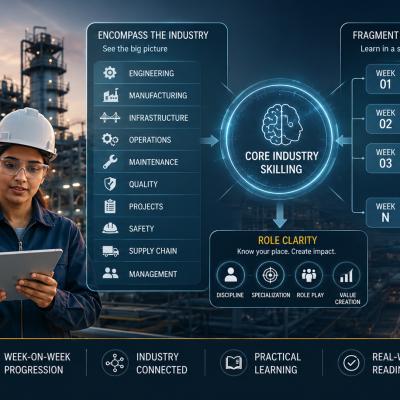
A meaningful skilling framework must include:
- Transition from academic knowledge to usable skill sets.
- Daily and progressive learning rather than one-time exposure.
- Mentoring that explains not only what to do, but why it is done.
- Standards, practices, incident lessons, and workplace logic.
- Scenario-based application and disciplined reflection.
- Stronger linkage between institutes, industry, and employability outcomes.
This is especially important in core engineering, manufacturing, and infrastructure, where performance depends on applied judgment, safety awareness, systems thinking, and contextual decision-making.
These are not capabilities that emerge automatically from a classroom. They must be cultivated deliberately.
Human capital is the national advantage
The future of India’s growth will not be decided only by investments, policies, or industrial announcements. It will be decided by whether the country can create a workforce capable of sustaining that growth with quality and speed.
Human capital is not a support function in nation building. It is the foundation.
A country becomes globally respected in core sectors when its people are trusted for competence, reliability, and productivity. That trust is built through skilling. And skilling becomes powerful only when it is structured, scalable, and deeply connected to real industry needs.
India already has the talent base. What it needs now is a stronger transition engine.
Why Buddy Mentor exists
Buddy Mentor has been built around this need.
Our belief is simple: India does not merely need more graduates. India needs more industry-ready professionals.
That is why Buddy Mentor focuses on transitioning academic knowledge gained by diploma and degree engineers into practical, work-aligned skill sets. Through a structured mentoring journey, industry logic, progressive daily skill chapters, and an AI-enabled learning architecture, the goal is not just to teach more. The goal is to prepare better.
If India wants to lead the world in core engineering, manufacturing, and infrastructure, it must first lead in how it develops human capability for those sectors.
That journey must begin now.