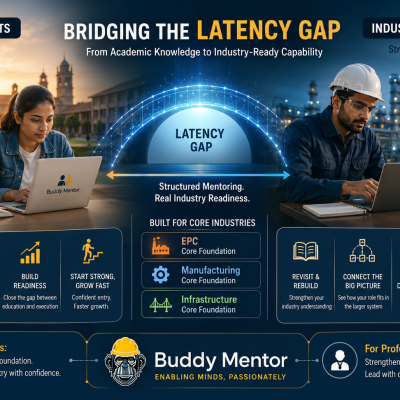
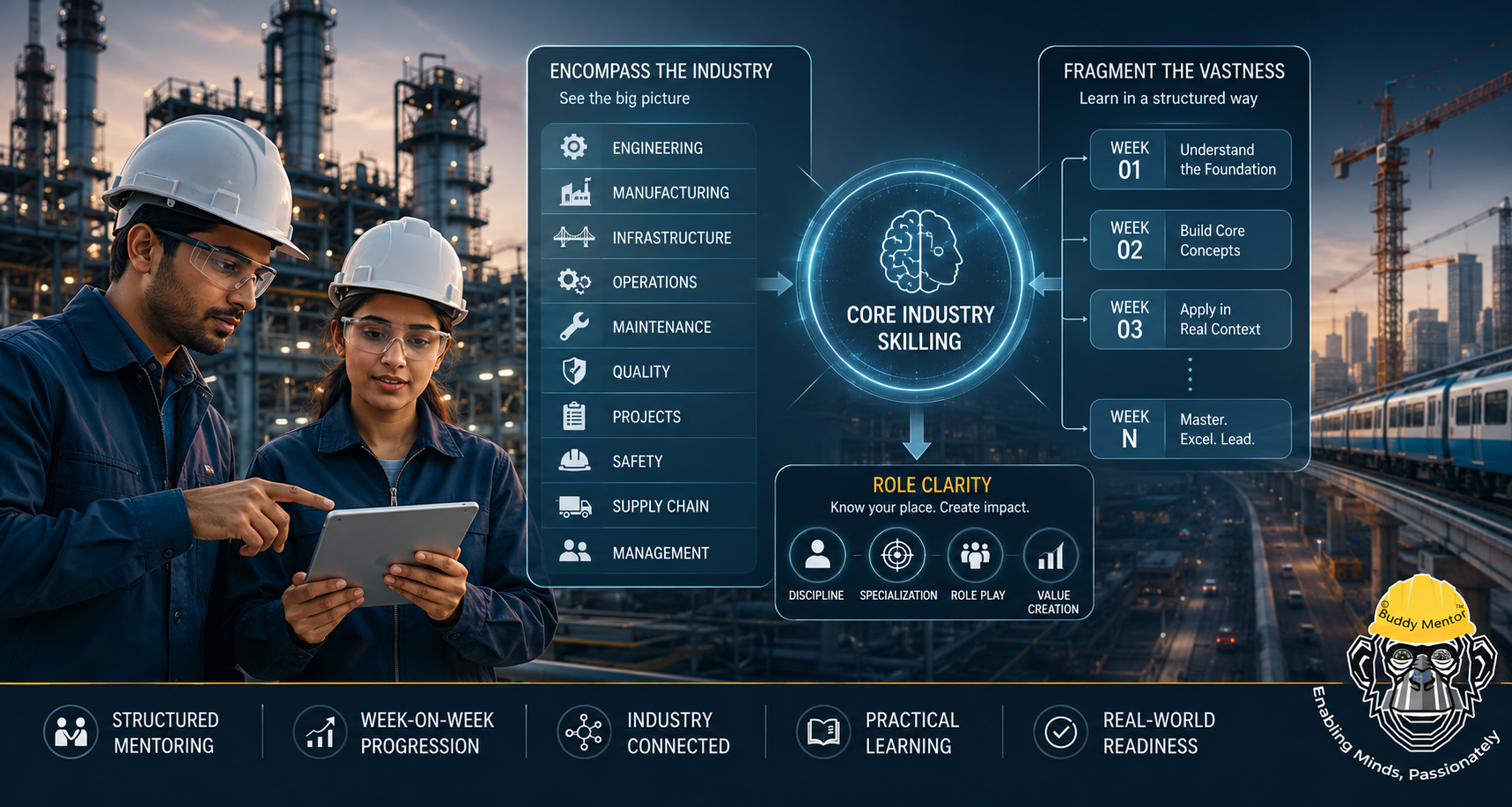
Core industry skilling is not a content problem. It is an architecture problem.
That is where most skilling models fall short.
In soft-skill domains, the learning landscape is relatively broad but manageable. In core industries, the landscape is fundamentally different. Engineering, manufacturing, and infrastructure are not narrow subjects that can be covered through a few modules or a limited training track. They are massive industrial ecosystems. Each one is an ocean of processes, disciplines, functions, standards, systems, and role dependencies.
That is why conventional skilling approaches often solve only a small part of the problem. A course may address one topic. A training program may strengthen one toolset. A curriculum may prepare a learner for one portion of the job. But core industry readiness demands something much larger.
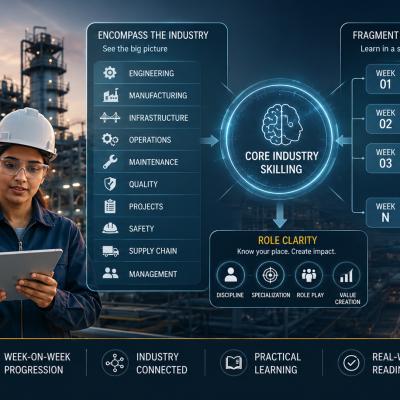
It demands a model that can first encompass the vastness of the industry and then fragment that vastness into a meaningful, learnable progression.
That is the real challenge.
The first challenge: encompassing the industry
A learner cannot be truly prepared for the core industry by understanding only isolated technical pieces.
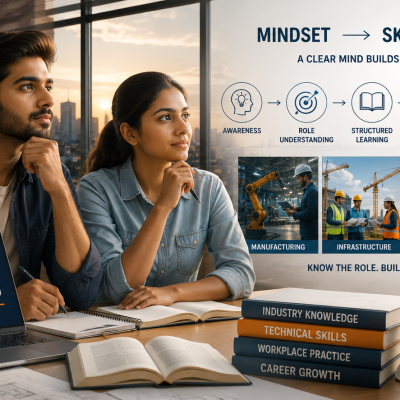
To become industry-ready, the individual must first see the whole field. They must understand how the industry functions, how its disciplines connect, where their specialization fits, and how roles contribute to the larger industrial outcome. Without that wider view, learning becomes narrow, disconnected, and incomplete.
This is the first and often ignored challenge in core sector skilling: how do we encompass the industry in a way that gives the learner a real sense of the total landscape?
At Buddy Mentor, this is addressed through week-on-week skill titles that progressively open the industry to the learner. The purpose is not to overload. The purpose is to create structured breadth. Each week expands industrial understanding. Each title adds another layer of clarity. Each step helps the learner see more than a topic; it helps them see the system. That kind of progressive breadth is critical for meaningful readiness.
The second challenge: fragmenting the vastness
But breadth alone does not build capability.
Once the learner begins to understand the size and structure of the industry, the next challenge becomes even more important: how do we break that vastness into meaningful fragments that can actually be learned, retained, and applied?
This is where most programs become shallow or chaotic. If the fragmentation is weak, the learner feels overwhelmed. If the fragmentation is arbitrary, the learner loses continuity. If the fragmentation is not role-aware, the learner may consume information without developing professional direction.
Fragmentation is not simplification. It is precision.
It requires a mentoring architecture that can divide large industrial knowledge into smaller, logical, progressive units without losing the context of the bigger picture. That is exactly where the Buddy Mentor patent-published mechanism brings value. It is designed to transform industrial vastness into structured, meaningful fragments that a learner can progressively absorb and connect.
This is not about breaking learning into random chapters. It is about breaking it into purposeful units that build understanding week after week.
Why this matters
A person entering core industry needs two things at the same time.
First, they need a broad understanding of the industry itself. Second, they need clarity about their own discipline, specialization, and roleplay within that industry.
Most skilling systems provide one without the other. Some give narrow specialization without context. Others give broad theory without role clarity. Neither creates true readiness.
Real mentoring must do both.
The learner must know the ocean, but they must also know where they stand within it. They must understand the industry as a whole, while also understanding how their own role creates value inside that industrial system.
That is when learning becomes meaningful. That is when knowledge starts turning into identity, confidence, and applied capability.
Why Buddy Mentor is built this way
Buddy Mentor is built on the belief that core industry skilling cannot be reduced to course delivery.
It must be a structured mentoring process. It must create industrial awareness before narrow skill dependency. It must establish progression before complexity. It must offer both encompassing breadth and meaningful fragmentation.
That is why the Buddy Mentor model is designed to help individuals understand the overall industry, recognize the place of their discipline or specialization, and grow through a guided sequence that makes industrial learning practical and connected.
In core industries, readiness is not created by information alone. It is created by architecture.
India needs stronger human capital for engineering, manufacturing, and infrastructure, then skilling systems must be designed with that level of seriousness.
Buddy Mentor is building a structured mentoring architecture for core industry readiness. Explore how our week-on-week skill progression helps learners understand the industry, their each skill day specialization, and their role within it.